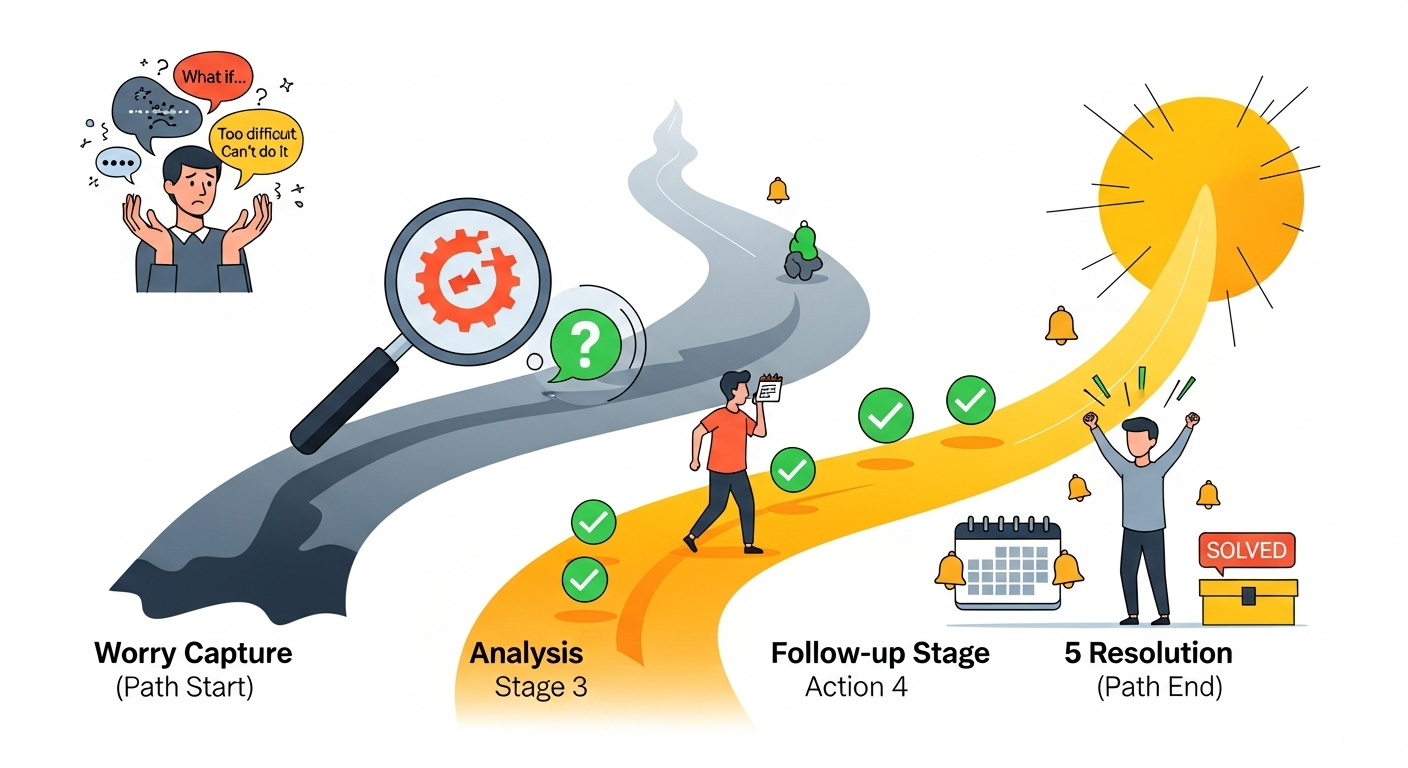
From Worry to Action: The Complete Problem Lifecycle in Worress
Most people treat problems like pop-up notifications: they appear, you react, you hope they go away, and if they don't, you stress about them indefinitely.
There's a better way.
Problems aren't random events—they're entities with a lifecycle. They're born (capture), they're understood (analysis), they're addressed (action), they're monitored (follow-up), and they're resolved (closure). When you manage this lifecycle intentionally, everything changes.
This is the core framework behind Worress.
The Problem with How We Handle Problems
Let's be honest about what usually happens:
Stage 1: Vague Awareness
"Something's bothering me."
Stage 2: Mental Replay
You think about it. A lot. While driving. Before bed. During meetings.
Stage 3: Anxiety Escalation
The more you think, the bigger it feels.
Stage 4: Paralysis or Panic
You either freeze (avoid it) or spiral (obsess over it).
Stage 5: Exhaustion
You're tired of thinking about it but haven't actually solved anything.
Notice what's missing? Action. Progress. Resolution.
Without a system, problems don't get solved—they get endured.
The Worress Problem Lifecycle: 5 Stages to Resolution
Worress transforms chaotic worry into systematic progress through five clear stages:
Stage 1: Capture 📥
Goal: Get the problem out of your head and into a system.
What happens:
- You describe the problem in your own words (messy is fine)
- You can type it, speak it, or even photograph it (AI analyzes images)
- Worress timestamps and stores it immediately
- Your mental load decreases the moment it's externalized
Why this matters:
Research shows that externalizing worries reduces intrusive thoughts by 40%. Once it's captured, your brain can stop rehearsing it.
Example:
Instead of lying awake thinking "I need to figure out my finances," you capture it: "I'm worried about money. I don't have enough savings. My spending feels out of control. I don't know where my money goes each month."
Result: The worry is now data you can work with, not noise cycling in your head.
Stage 2: Breakdown & Analysis 🧠
Goal: Transform a vague problem into specific, actionable components.
What happens:
- AI analyzes your problem and identifies sub-issues
- System separates controllable from uncontrollable factors
- You see what you're actually dealing with (often less scary than the vague worry)
- Patterns are identified if this connects to previous problems
Why this matters:
Problems feel overwhelming when they're abstract. Specificity creates solvability. Once you see the pieces, you can address them individually.
Example:
Your vague "worried about money" becomes:
- No emergency fund (controllable - can start saving)
- Unclear spending (controllable - can track for 2 weeks)
- Impulse purchases (controllable - can set rules)
- Low income (partially controllable - can explore raises/side income)
- Rising costs of living (uncontrollable - acknowledge and plan around)
Result: Five distinct challenges instead of one amorphous anxiety.
Stage 3: Action Planning & Execution ✅
Goal: Move from understanding to doing.
What happens:
- AI suggests specific first steps for each sub-problem
- You choose which actions to commit to
- Actions are tracked with deadlines and statuses
- You complete actions and mark them done
- Momentum builds visibly
Why this matters:
Insight without action is just expensive procrastination. The goal isn't to think better—it's to live better. That requires action.
Example:
For your money worry:
- ✅ This week: Track every dollar spent for 7 days
- ✅ Next week: Open high-yield savings account
- ✅ Week 3: Set up automatic $50/week transfer to savings
- ✅ Week 4: Identify one subscription to cancel
- ✅ Ongoing: Use "24-hour rule" before non-essential purchases over $30
Result: Instead of worrying about money, you're actively improving your financial situation.
Stage 4: Follow-Up & Adjustment 🔄
Goal: Ensure problems stay solved and actions stay relevant.
What happens:
- Worress prompts check-ins at smart intervals (e.g., 1 week, 2 weeks, 1 month)
- You reflect: "Is this still a problem? What's changed? What's working?"
- Actions can be modified based on what you've learned
- Stagnant problems get flagged (preventing abandonment)
- Progress triggers positive reinforcement
Why this matters:
Life changes. What was urgent becomes irrelevant. What seemed solved resurfaces. Follow-ups ensure your problem-solving stays aligned with reality.
Example:
Two weeks into your money tracking:
- Check-in question: "How has tracking spending affected your finances?"
- Your reflection: "I discovered I spend $200/month on food delivery. I had no idea."
- New action: "Cook dinner 4x/week, budget $50 for occasional delivery."
- Result: The problem evolved, and your approach adapted.
Follow-ups also catch sneaky problem-drift:
You started trying to save money, but now you realize the real issue is that you're bored and shopping fills the void. New problem identified: need fulfilling hobbies.
Stage 5: Resolution & Learning 🎯
Goal: Close the loop and extract wisdom for the future.
What happens:
- You mark the problem as resolved when it's no longer active
- Worress prompts reflection: "What worked? What didn't? What did you learn?"
- Successful strategies can be saved as a "Playbook" for future use
- Progress data shows you how long it took, what actions mattered most
- You build confidence: "I solved this. I can solve the next one."
Why this matters:
Every solved problem is a training session for your future self. Capture the lesson, and next time is easier.
Example:
After 8 weeks, your money worry is resolved:
- Emergency fund started: $400 saved
- Spending tracked and understood
- One subscription canceled, delivery habits changed
- You feel in control instead of anxious
Reflection captured:
"Tracking spending was the game-changer. I thought I needed to earn more, but I actually needed to see where money was going. Now I have a system."
Playbook created:
"How I Take Control of Finances"
- Track all spending for 2 weeks
- Identify biggest surprise expense
- Set one boundary around that expense
- Automate savings before you can spend it
Result: Next time you feel financial anxiety, you don't start from scratch. You have a proven process.
How This Differs From Traditional Approaches
| Traditional Approach | Worress Lifecycle |
|---|---|
| Worry in your head | Captured in system |
| Vague, overwhelming | Broken into pieces |
| "I should do something" | Specific actions with deadlines |
| Forget to follow through | Automated check-ins |
| Problem fades or festers | Explicit resolution + learning |
| Start from scratch next time | Reuse successful strategies |
The difference? Structure. Continuity. Completion.
Real-Life Example: Jake's Relationship Problem
Stage 1: Capture
Jake captures: "My partner and I keep having the same fight about chores. I'm frustrated and don't know how to fix it."
Stage 2: Breakdown
AI identifies:
- Unequal distribution of household tasks
- Different standards of cleanliness
- Lack of explicit agreements about who does what
- Resentment building from unspoken expectations
- Poor communication about needs
Stage 3: Action
Jake commits to:
- ✅ Week 1: List all household tasks that need doing
- ✅ Week 2: Have conversation with partner about division preferences
- ✅ Week 3: Create shared chore chart with agreed responsibilities
- ✅ Week 4: Try the new system and track friction points
Stage 4: Follow-Up
After 2 weeks, check-in reveals:
- The chart helped, but "deep cleaning" expectations still differ
- Partner feels nagged when Jake points out missed tasks
- New action: Schedule weekly 10-minute "chore review" instead of real-time complaints
Stage 5: Resolution
After 6 weeks:
- Chore system working smoothly
- Fights down 80%
- Both feel heard and respected
Playbook created:
"How We Handle Household Disagreements"
- Make implicit expectations explicit
- Create visual system (chart, shared list)
- Schedule dedicated time to discuss issues (not mid-conflict)
- Revisit and adjust after trial period
Next time a household conflict arises (and it will), Jake has a framework that worked once and can work again.
Why the Lifecycle Model Works: The Psychology
1. Closure Effect
The human brain craves completion. Open loops (unresolved problems) consume mental energy. The lifecycle ensures problems reach resolution, freeing cognitive resources.
2. Progress Principle
Research by Teresa Amabile shows that visible progress is the #1 motivator. Tracking lifecycle stages makes progress tangible.
3. Reflective Practice
Learning scientists confirm that reflection after action dramatically improves skill development. The follow-up and resolution stages build problem-solving competence over time.
4. Implementation Intentions
Studies show that specific "if-then" plans (created in the action stage) increase success rates by 300%. The lifecycle forces this specificity.
Common Lifecycle Challenges (And How Worress Handles Them)
Challenge: "I capture problems but never act on them"
Worress solution: Action suggestions appear immediately after breakdown. You're not left wondering "what now?"
Challenge: "I start actions but lose momentum"
Worress solution: Automated check-ins prevent abandonment. Stagnant problems get flagged.
Challenge: "I solve a problem but it comes back"
Worress solution: Follow-ups catch recurrence early. Playbooks preserve successful strategies.
Challenge: "I have too many problems to manage lifecycles for all of them"
Worress solution: Prioritization tools help you focus on what matters most. Not every worry needs the full lifecycle—some just need acknowledgment.
The Compounding Effect of Lifecycle Management
Here's what happens when you manage multiple problems through their complete lifecycle:
Month 1:
You solve one problem properly (financial anxiety). You learn a process.
Month 2:
You apply the same lifecycle to a work conflict. It resolves faster because you know the steps.
Month 3:
You tackle a health goal using the framework. You create another playbook.
Month 6:
You have 5 solved problems, 5 playbooks, and a track record that proves to you: "I can handle challenges systematically."
Month 12:
New problems feel less scary because you trust the process. You've become a better problem-solver not through intelligence, but through system.
This is the compounding effect. Each lifecycle completion strengthens the muscle.
Your Invitation: Start One Lifecycle Today
You don't need to overhaul your entire life. You need to take one problem through one complete lifecycle.
Pick something manageable:
- A minor frustration at work
- A habit you want to build
- A relationship tension
- A personal goal that's been stalled
Then follow the five stages:
- ✅ Capture it in Worress
- 🧠 Let AI break it down
- ✅ Commit to first actions
- 🔄 Check in after one week
- 🎯 Reflect when it's resolved
One complete lifecycle will teach you more than a dozen self-help books.
Because you're not just learning about problem-solving. You're experiencing systematic resolution.
Start Your First Problem Lifecycle Free - Transform one worry into one win, then build from there.