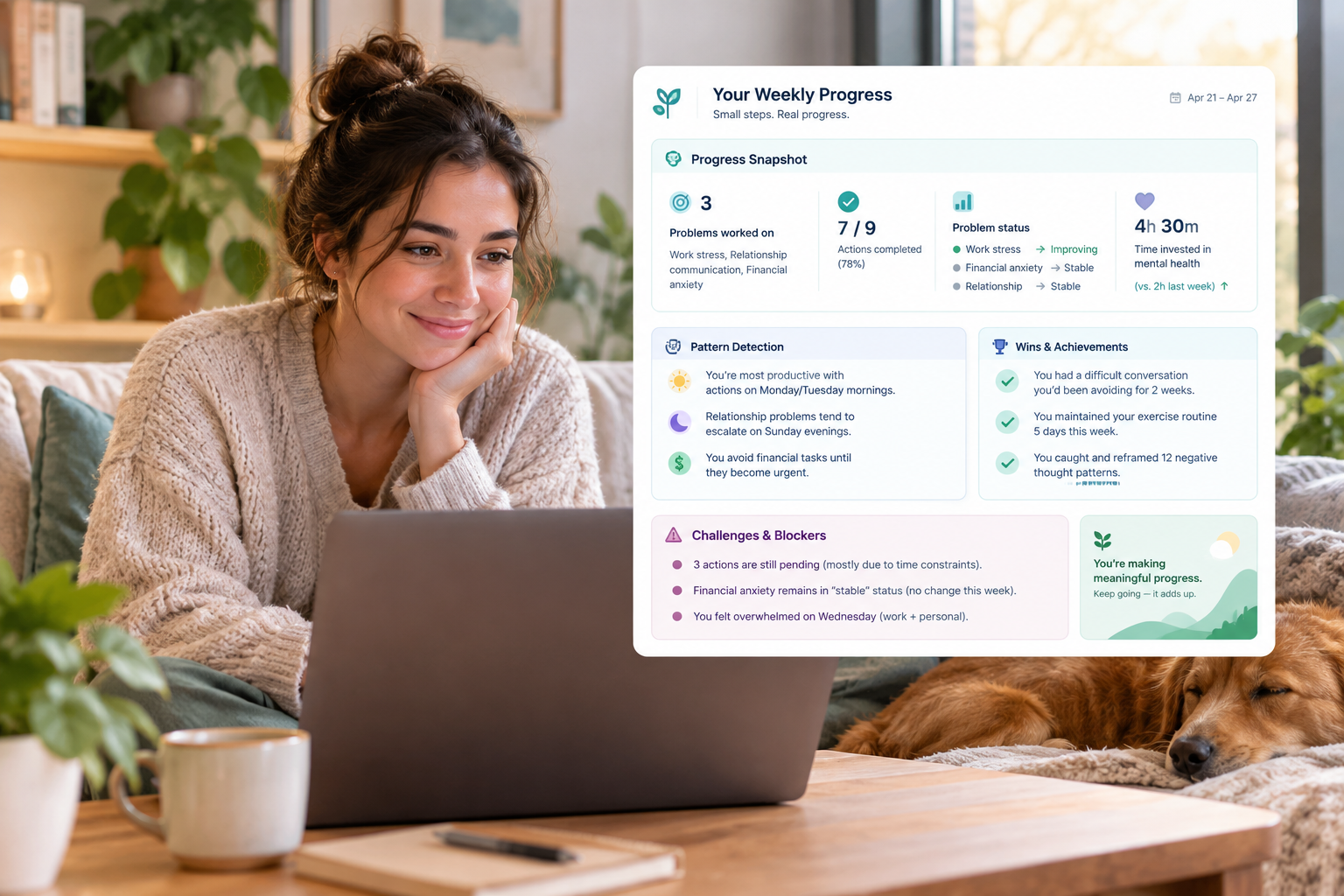
See Your Growth: Weekly Progress Summaries
It's Friday evening. You reflect on the week and think: "What did I even accomplish? Did I make progress on anything?"
You took actions. You worked on problems. But without a clear picture, it all feels like a blur.
This is the visibility problem: Growth happens in small increments that are invisible day-to-day but significant over weeks.
Worress Weekly Progress Summaries solve this by showing you what you can't see on your own.
Why Weekly Summaries Matter
Daily perspective is too narrow
When you're in the middle of working on a problem, you can't see progress. You notice what's still broken, not what's improved.
Monthly perspective is too wide
Waiting a month to review progress means you miss important patterns and lose opportunities to course-correct.
Weekly is the goldilocks zone
Long enough to see meaningful patterns. Short enough to stay responsive and adaptive.
What's in Your Weekly AI Summary
1. Progress Snapshot
- Problems actively worked on
- Actions completed vs. committed
- Movement in problem status (improving, stable, worsening)
- Time invested in mental health this week
Example Output: "This week you worked on 3 problems: Work stress, relationship communication, and financial anxiety. You completed 7 of 9 committed actions (78%). Work stress moved from 'critical' to 'improving'. Financial anxiety remained stable."
2. Pattern Detection
Beri may surface recurring themes across your week:
- "You're most productive with actions on Monday/Tuesday mornings"
- "Relationship problems tend to escalate on Sunday evenings"
- "You avoid financial tasks until they become urgent"
Why this matters: Patterns you notice, you can change.
3. Wins and Achievements
Celebrates what you accomplished:
- "You had a difficult conversation you'd been avoiding for 2 weeks"
- "You maintained your exercise routine 5 days this week"
- "You caught and reframed 12 negative thought patterns"
Why this matters: Your brain focuses on what's wrong. The summary balances this with what's right.
4. Challenges and Blockers
Identifies what's holding you back:
- "3 actions were marked incomplete due to 'lack of time' - suggests prioritization or boundary issue"
- "You haven't checked in on 'career transition' problem in 10 days - still relevant?"
Why this matters: Awareness of blockers is the first step to removing them.
5. AI-Generated by Beri — review before acting
Smart observations you might miss:
- "Your anxiety levels correlate with skipping morning routine"
- "Problems you tackle immediately resolve 2x faster than ones you delay"
- "Your completion rate increases when actions are specific vs. vague"
Why this matters: Insights lead to strategy changes that accelerate progress.
6. Recommended Next Steps
Based on the week's data, Beri may suggest focus areas:
- "Continue momentum on work stress - schedule follow-up for next week"
- "Financial anxiety hasn't received attention in 2 weeks - time to revisit?"
- "Your cognitive reframing practice is working - consider teaching it to someone else to deepen learning"
Why this matters: You don't have to guess what to prioritize. The data tells you.
Real Example: Sarah's Week 4 Summary
Progress Snapshot:
- 4 problems active: Social anxiety, procrastination, sleep issues, body image
- 11/13 actions completed (85%)
- Social anxiety: Improved (attended 2 social events, minimal panic)
- Procrastination: Stable (used pomodoro technique 4x)
- Sleep issues: Worsening (average 5.5 hours, down from 6.5)
- Body image: No activity this week
Patterns Detected:
- "You complete exercise-related actions 100% of the time but reflection-based actions only 50%"
- "Sleep quality drops on nights you work past 8 PM (happened 4x this week)"
- "Social anxiety reduces when you prepare conversation topics in advance"
Wins:
- Attended networking event despite high anxiety
- Stopped mid-procrastination 3x and redirected using pomodoro
- Identified trigger for late-night work (fear of being behind)
Challenges:
- Sleep routine abandoned mid-week
- Body image problem hasn't been addressed in 3 weeks
- Tendency to over-schedule work commitments
AI Insights:
- "Your procrastination improves with structure (pomodoro) but worsens with vague tasks. Recommendation: Break all tasks into 25-min chunks."
- "Sleep is your leverage point - better sleep improves anxiety, focus, and mood. Prioritize this."
Next Steps:
- Make sleep non-negotiable: Set 10 PM work cutoff
- Schedule 15-min body image reflection (address avoidance)
- Continue social exposure (momentum building)
- Break next week's tasks into specific 25-min blocks
Sarah's reaction:
"I didn't realize how much working late was destroying my sleep. Seeing it in data made me take it seriously. And I forgot I'd attended that networking event - felt good to see that called out as a win."
How Weekly Summaries Change Behavior
Before Weekly Summaries:
- Sarah vaguely felt "behind"
- Didn't notice wins
- Repeated unproductive patterns
- Guessed what to work on next
After Weekly Summaries:
- Clear picture of what's working and what's not
- Acknowledged progress, which motivated continued effort
- Adjusted strategy based on patterns (work cutoff time)
- Data-driven prioritization (sleep became priority)
The summary provided clarity that gut feeling couldn't.
The Science of Progress Tracking
Research by Teresa Amabile (Harvard) shows that visible progress is the #1 motivator for sustained effort.
Weekly summaries create visibility in three ways:
- Retrospective clarity: "Here's what you actually did" (vs. what you feel you did)
- Pattern recognition: "Here's what's working" (vs. guessing)
- Forward guidance: "Here's what to focus on next" (vs. scattered attention)
Studies show people who track weekly progress:
- Are 30% more likely to achieve goals
- Experience 25% less burnout
- Report 40% higher satisfaction with growth efforts
Premium Feature: Comparative Analytics
Worress Premium includes multi-week comparisons:
Week-over-Week Trends:
- "Completion rate up 15% from last week"
- "Anxiety symptoms down 20% compared to 2 weeks ago"
- "You're spending 30% less time ruminating than a month ago"
Monthly Aggregates:
- "In the last 4 weeks, you resolved 3 problems that had been active for months"
- "Your most successful problem-solving pattern: immediate action + weekly check-ins"
Longitudinal Insights:
- "Problems you address within 48 hours of capture resolve 3x faster"
- "Your winter months show 20% higher anxiety - plan ahead for next year"
How to Get Maximum Value from Summaries
1. Schedule Review Time
Don't just skim. Block 15 minutes every Friday to actually read and reflect.
2. Act on Insights
If the summary suggests sleep is your leverage point, make sleep the priority for the next week.
3. Celebrate Wins Out Loud
Share one win with someone (friend, partner, therapist). Externalizing wins reinforces them.
4. Adjust Strategy Immediately
If patterns show you avoid certain action types, either change the actions or address the avoidance.
5. Export and Save
Keep summaries. Looking back 3 months later is incredibly motivating.
Common Reactions to First Summary
"I didn't realize I'd done that much."
You're not giving yourself credit for incremental progress.
"Seeing it in data makes my problems feel more manageable."
Objectivity reduces emotional overwhelm.
"I keep making the same mistake every week."
Now you can see the pattern and interrupt it.
"I'm avoiding one problem entirely."
Awareness is the first step to addressing avoidance.
Your Weekly Summary Experiment
Commit to one month of weekly summaries:
Week 1: Read your first summary. Notice how it compares to your gut feeling about the week.
Week 2: Act on one insight from the previous summary. See if it makes a difference.
Week 3: Look for patterns across summaries. What keeps showing up?
Week 4: Compare Week 4 to Week 1. How have you evolved?
After one month of weekly reviews, you'll have clarity most people never achieve.
Get Your First Weekly Summary - See your growth. Accelerate your progress.
AI-assisted, informational use: Where this article describes generated suggestions or summaries, they may be produced by Beri, an AI support assistant. Outputs may be incomplete or wrong; review them and decide what fits. Worress is not a therapist, diagnosis, or emergency service.